

By Damion Tyrell, Technology Corporate Electric
"Electrical services" sounds like one simple thing until something goes wrong and you discover how many different systems sit under that one phrase. A panel, a kitchen circuit, a storefront's lighting, a warehouse machine feed — each is a different job, with different code rules, different risks, and a different order of work. This guide teaches what full-service electrical work actually covers, so Markham homeowners, business owners and facility managers can recognize what they need, what a proper job looks like, and when a fault stops being a maintenance item and becomes urgent.
Technology Corporate Electric provides electrical services in Markham and across Ontario for residential, commercial and industrial clients — all three sectors, served across all of Ontario from our Toronto and GTA base.
Lesson one: every electrical service starts at the panel
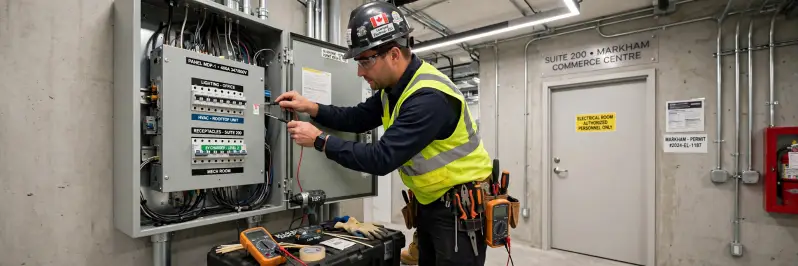
The panel is the heart of the system, and almost every service call traces back to it sooner or later. Full-service electrical work begins with understanding capacity: how large the service is, how the circuits are distributed, whether the panel schedule is accurate, and how much headroom is left for what the building wants to do next.
Warning signs that the panel needs attention first include breakers that trip repeatedly, a panel that feels warm, buzzing at the panel, and circuits that were added over the years without the schedule ever being updated. A proper service visit documents what is actually there before recommending anything — a panel upgrade in Toronto and the GTA is the right answer only when the load calculation says the existing service genuinely cannot carry the building safely.
Lesson two: residential, commercial and industrial work share rules but not scale
In a Markham home in Unionville, Angus Glen or Cornell, electrical services usually mean dedicated circuits for kitchens and laundry, GFCI and AFCI protection where the Ontario Electrical Safety Code requires it, lighting, EV charging, and repairs that restore a circuit properly instead of masking the fault. The teaching point for homeowners is simple: a receptacle that stops working is a symptom, not a diagnosis — the cause can be a tripped GFCI upstream, a failed connection inside a box, or an overloaded circuit, and each cause has a different correct repair.
In commercial premises along Highway 7 or in a Markham plaza, the same principles scale up: tenant fit-outs, lighting maintenance, emergency and exit lighting testing, and dedicated power for kitchen, refrigeration and point-of-sale equipment. Our commercial electrical services keep that work documented so property managers can show tenants and inspectors exactly what was done.
In industrial units, electrical services extend to three-phase distribution, motor feeds and controls, and machine circuits where downtime is measured in lost production. Our industrial electrician services across Ontario apply the same discipline — calculate, protect, label, test — at production scale.
Lesson three: safety and inspection are part of the service, not extras
In Ontario, most new electrical work requires a notification filed with the Electrical Safety Authority and an inspection of the finished job. The Electrical Safety Authority publishes the code and inspection requirements that govern this work across the province. That process is not paperwork added to the bill; it is how a repair or installation becomes a documented, insurable part of the building's record.
A proper job, step by step, looks like this: assess and diagnose first, explain the options in plain language, file the notification where the work requires it, complete the work to code with connections made inside proper boxes, test under load, label the panel accurately, and leave the record with the owner. Any shortcut in that sequence — especially skipping diagnosis or inspection — is where repeat failures come from.
Lesson four: know when a service call becomes an emergency
Some faults can be scheduled. Others cannot wait: a burning smell from a panel or receptacle, sparking, a panel that is hot to the touch, or a partial outage affecting half the building all need same-day attention. Our guide to recognizing those signs, and our emergency electrician service in Toronto and the GTA, explain what to do in the first minutes — switch off the affected circuit if it is safe to do so, keep people away from a hot or sparking device, and call rather than waiting to see whether it settles.
Prevention is the quieter half of electrical services: periodic panel checks, torque and heat checks on connections, testing GFCI devices, and planning additions against real capacity instead of adding load until something trips. Buildings that are maintained this way have fewer emergencies, because most emergencies announce themselves as small warning signs first.
To book electrical services for a home, a business or a plant, contact Technology Corporate Electric — call 437-435-7053 for residential, commercial and industrial service across Markham, Toronto, the GTA and all of Ontario.
By Damion Tyrell, Technology Corporate Electric
Add comment
Comments