

By Damion Tyrell, Technology Corporate Electric
Every year, Ontario homes and businesses burn, and people — including children — are hurt by electrical work that was done cheap, done under the table, or done by somebody who was never qualified to touch it. The part most people only learn afterwards is the second disaster: when the insurance company investigates and finds the work was not done by a licensed electrical contractor, the claim can be denied and the building left effectively uncovered for that loss. This guide explains how the law, the safety risk and the insurance rules actually fit together. If you want the short version applied to your own property, start with Technology Corporate Electric and our page of electrical service options for Ontario properties. We serve residential, commercial and industrial customers across Toronto, the GTA and all of Ontario.
What "licensed" actually means in Ontario
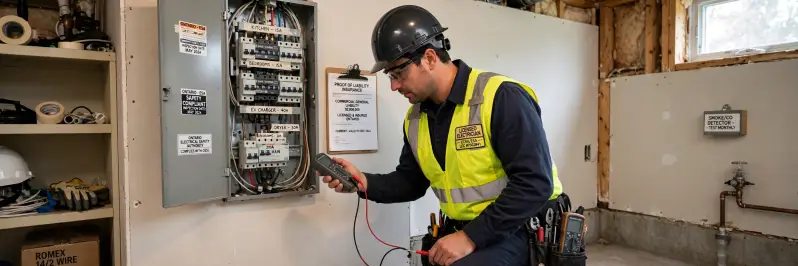
In Ontario, if you hire anyone to do electrical work in your home or business, that business must be a Licensed Electrical Contractor, licensed by the Electrical Safety Authority (ESA) through ECRA/ESA. The individual doing the work must be a certified electrician, and a Master Electrician must oversee the business. This is not a marketing label — it is the law, and it applies to a panel change in a house the same way it applies to wiring in a factory.
There is exactly one exception, and it is narrower than most people think: a homeowner may do electrical work in their own home themselves. Even then, the homeowner must file a notification (an application for inspection) with the ESA and have the work inspected. A handyman, a general contractor's "guy," a cash-only side job, or a friend who "knows electrical" does not fit the exception. When you hire out the work, the only legal option is a licensed electrical contractor — and the licence number should be on the quote, the truck and the contract. Our electrical service options for Ontario properties page sets out what licensed work looks like in practice, and Technology Corporate Electric serves homes, businesses and industry across the province.
The insurance problem nobody warns you about
Here is the sequence that plays out after an electrical fire. The fire department and the insurer both want to know the cause. Investigators look at the panel, the wiring and the devices. If the fire started at a receptacle that was installed last year by an unlicensed person — no ESA notification, no inspection, no record — the insurer has solid ground to dispute or deny the claim, because the policy was written on the assumption that the building's electrical system was installed and maintained to code by qualified people.
The same logic reaches further than fire. If a child is shocked at a receptacle that was wired wrong, or a family member is electrocuted by a fixture an unlicensed installer hung without a proper ground, the homeowner is left carrying liability that a licensed contractor's insurance and inspection record would have stood behind. And the damage is not limited to the day of the loss: uninspected work discovered later — by a home inspector, a buyer's electrician, or the ESA — has to be opened up, inspected and often redone at the owner's cost before a sale can close. The money "saved" on the cash job is repaid several times over, with interest, at the worst possible moment.
The honest way to say it: a licensed contractor's ESA notification and passed inspection are not paperwork for their own sake. They are the paper trail that proves, to your insurer and to the next buyer, that the work was done to the Ontario Electrical Safety Code by someone accountable for it.
Why unlicensed work fails: the safety lesson
Electrical work fails in predictable ways when it is done by people without training, and the failures hide inside walls where nobody sees them until they announce themselves:
- Loose connections are the classic fire starter. A conductor landed without proper torque heats up under load, arcs, and slowly cooks the insulation around it — for months, quietly, before it ignites.
- Wrong protection. An oversized breaker on undersized wire lets the wire become the fuse. Backstabbed receptacles, missing GFCI protection in kitchens, bathrooms and outdoors, and absent AFCI protection in bedrooms are the findings inspectors write up again and again.
- Grounding mistakes. A receptacle that tests "fine" but has no real ground path gives a fault nowhere to go except through the person touching the appliance. This is the electrocution risk, and children — smaller bodies, wet hands, curiosity about outlets — are the most vulnerable people in the house. Tamper-resistant receptacles, proper GFCI protection and real grounding are not upgrades; they are the code minimum a licensed installer delivers by default.
- Aluminum wiring and knob-and-tube demand specific, listed methods. Done wrong, both are fire risks; done by a licensed contractor, both are managed safely every week.
A licensed electrician is trained to the code, inspected by the ESA, and insured for the work. That combination — training, inspection, insurance — is the entire product. The cheaper quote removes all three and keeps the risk in your walls.
Commercial and industrial: the stakes are higher, not lower
Everything above applies to businesses with sharper edges. A commercial property owner or tenant who hires unlicensed electrical work is exposed on several fronts at once:
- Business insurance. A fire traced to unlicensed work in a restaurant, plaza unit or office can void the property and liability claim the same way it does in a home — except now the loss includes stock, equipment, neighbouring tenants' damage and business interruption that may not be covered either.
- People. If an employee or a customer is injured by faulty electrical work, the owner faces WSIB consequences, Ministry of Labour scrutiny and personal liability — with no licensed contractor's insurance standing in front of them.
- ESA enforcement. The ESA can issue orders and stop-work directives on unlicensed or uninspected installations, and a business can be shut down until the work is brought into compliance.
- Industrial specifics. In plants and warehouses, unqualified work on motor controls, distribution and high-voltage systems adds arc-flash risk, equipment damage and production downtime to the list. Insurers audit industrial electrical maintenance; undocumented, unlicensed work is exactly what those audits are designed to find.
Landlords should read this twice: renting out a property does not transfer the risk. The owner who let a handyman rewire a rental unit owns the consequences when something goes wrong in it.
How to protect yourself: a five-minute checklist
- Ask for the ECRA/ESA licence number before you sign anything, and verify the contractor on the ESA's contractor locator at esasafe.com. A legitimate contractor expects the question.
- Confirm the ESA notification. For most work, a notification of work must be filed and the finished job inspected. Ask who files it (the contractor does) and keep the certificate of inspection with your house or property records.
- Get the quote in writing with the licence number on it. No licence number on the paperwork is your answer about the paperwork.
- Never pay cash to avoid the paper trail. The paper trail is the protection — it is what your insurer, your buyer and the ESA will ask for.
- If you already have unlicensed work in the building, have a licensed contractor assess it and arrange the inspection route to bring it into compliance. Discovered-and-fixed beats discovered-by-a-fire-investigator every time.
Planning ahead is the economic lesson hiding inside the safety one. Permitted, inspected work costs a little more on the day it is done and dramatically less across the life of the building, because it never has to be done twice and never puts a claim at risk.
A practical next step
Before booking anything, gather the facts this lesson points at: photograph the nameplates and the panel schedule, note when the problem actually happens — time of day, weather, what else was running — and decide which single result the work must deliver. Bringing that page to the first conversation shortens the diagnosis, sharpens the quote, and keeps the scope honest on both sides of the counter.
Ontario's Electrical Safety Authority publishes the homeowner and business version of these rules at esasafe.com, including the contractor locator for verifying a licence before you hire.
Talk to a Toronto electrician
Questions about hiring a licensed electrician and protecting your insurance coverage in your own home or building? Contact a Toronto electrician at Technology Corporate Electric. Call 437-435-7053 for residential, commercial and industrial electrical service across Toronto, the GTA and all of Ontario.
By Damion Tyrell, Technology Corporate Electric
Add comment
Comments